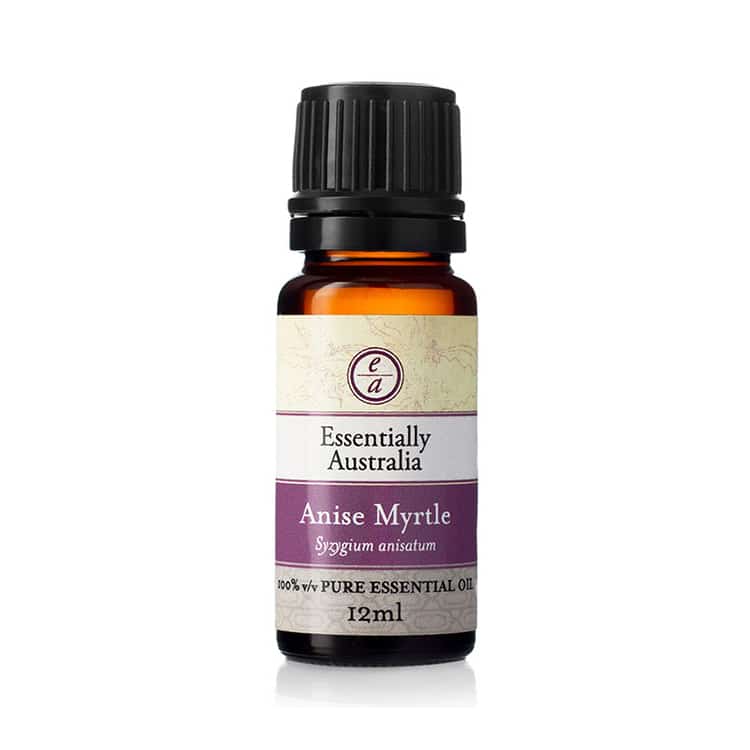
Anise Myrtle Essential Oil (Aniseed Myrtle Oil)
Anise Myrtle essential oil is clearly superior to any of the other traditional, aniseed essential oils. Anise Myrtle is far fresher and a little stronger and purer in its Aniseed aroma than regular Aniseed essential oils.
Anise Myrtle is simply the best Aniseed type essential oil in the world. We have conducted focus groups on traditional exotic Aniseed and Anise and convincingly found the native Anise Myrtle to be the preferred oil!
Botanical name Syzygium anisatum (previously Backhousia anisata)
Ingredients 100% v/v pure Anise Myrtle essential oil (Aniseed Myrtle oil).
Aroma
Licorice, aniseed, fresher and more pleasant than traditional anise and aniseed. Pleasant for men, women and especially children, especially if they like licorice sweets!
Benefits
Good for relaxing, relaxing in the bedroom at night, air freshening, grounding, calming, masks other scents, bad flavours and bad smells.
Uses
In an oil burner, vaporiser, potpourri, massage oil, bath. Add a few drops to a food mix for a wonderful Anise flavour or mask a bad flavour. Use in washing products to eradicate or mask bad smells. Use in cleaning animals and animal kennels. Anise Myrtle oil attracts fish to fish lures.
Please take a look at our Anise Myrtle essential oil video
More Uses
| Aromatherapy Oil | 2 to 4 drops in an oil burner, a couple of drops in a vaporiser, 1 to 2 drops into a bath. |
| Massage | 1 drop per 20ml of carrier oil (Anise Myrtle oil can cause skin sensitisation). |
| Mix into | Soaps, washing liquids at 0.5% to 1% |
Key Chemical Constituents
trans-anethole, equal or greater than traditional Aniseed or Star Anise.
Precautions
Do not use during pregnancy. anethole can be a dermal irritant. Keep out of reach of children, store away from direct sunlight, store below 30 degrees.
Other Common Names
Aniseed Myrtle, Ringwood.
Previous Botanical Names
Backhousia anisata, Anethola anisata.
Natural Occurrence in Australia
A rainforest tree to 40 metres, very rare in the wild, limited to Bellinger and Nambucca Valleys of New South Wales.
Characteristics
Watery, strong, pleasant licorice or anise aroma.
Research
School of Biomedicial Sciences, Charles Sturt University, Australia studied the antibacterial activity of Syzygium anisata and demonstrated activity against some bacteria including Candida albicans and Staphylococcus aureus .
Extraction and Farming Method
Anise Myrtle essential oil is extracted via steam distillation of the stems and branches. Anise Myrtle is grown in plantations around northern New South Wales, these plantations were actually planted for the herb or bush tucker markets until the ‘rediscovery' of its unique essential oil.
The trees are harvested and are then steam distilled for around 1 hour. The harvesting is done by unique farm machinery designed by the farmers themselves, leaves are ‘pruned' like a hedge, a vacuum sucks the leaves into a bin and the leaves are placed into stainless steel boiler.
History
Traditional Usage
Little knowledge of traditional use is available, mainly because the tree is so rare and the traditional knowledge in this area has been largely lost.
Early European Usage
The trees were harvested during World War 2, when aniseed flavouring was in short supply, then ceased again after Wold War 2.
Present Day Usage
Bush Tucker pioneers Peter Hardwick and later Sibylla Hess-Buschmann, rediscovered the plant and began selecting superior genetic varieties, then established small plantations in northern New South Wales. Anise Myrtle essential oil was a later product after the herb was established.
Anise Myrtle herb or leaf has been demonstrated by the Australian Governments research department, RIRDC (Rural Industries and Research Development Corporation) that the leaf/herb has upto 5 times more antioxidants than Blueberries, it is several times higher in Lutein, Magnesium, Calcium, Manganese and Vitamin E compared to Blueberries.
Anise Myrtle is a new oil to the aromatherapy industry and has the potential to supersede traditional Aniseed essential oils on the basis of a superior Anethole content and a superior, fresher Anise aroma.
Blend Anise Myrtle Essential Oil with
Essentially Australia oils: Eucalyptus, Niaouli, Tea Tree
Other Oils: Cardamon, Caraway, Cedarwood, Coriander, Fennel, Manadarin, Petegrain, Rosewood.
Typical Constitution of Anise Myrtle Essential Oil (Aniseed Myrtle Essential Oil)
| alpha-phellandrane | 1.97% |
| 1,8-cineole | 0.40% |
| estragole (methyl chavicol) | 5.77% |
| z-anethole (cis-) | 0.48% |
| e-anethole (trans) | 87.33% |
Optical Rotation@ 20C: +3.5 – +12.0
Relative Density@ 20C: 0.895-0.915
Refractive index @ 20C: 1. 488-1.49