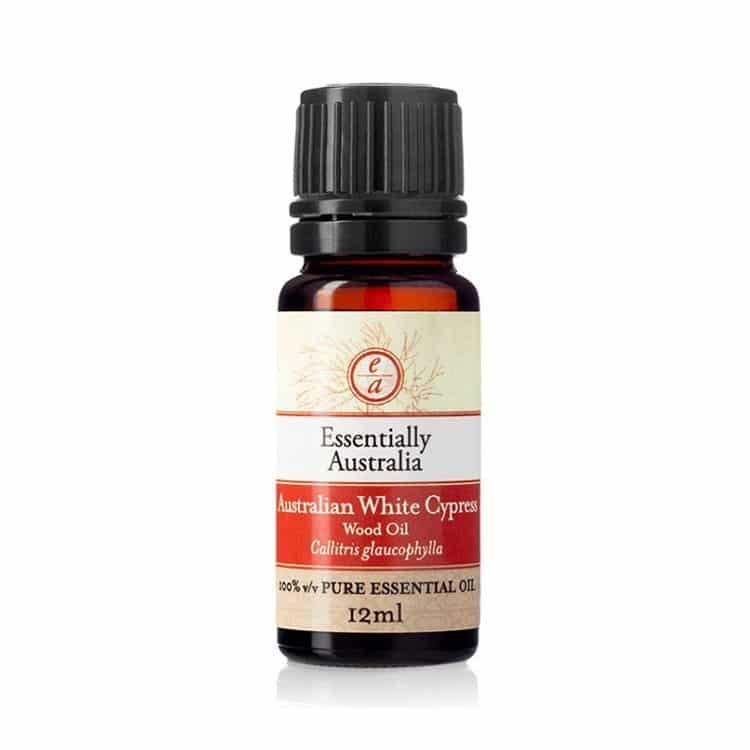
Australian White Cypress Wood Essential Oil
Australian White Cypress essential oil (wood oil), is a mild yellow honey coloured essential oil, naturally enough, it is calming, grounding. It is also good for tired joints and muscles.
Botanical name Callitris glaucophylla
Ingredients 100% v/v pure Australian White Cypress essential oil (distilled from the wood).
Aroma
A very, very earthy, woody, grounding, soothing aroma. A woody smell of the forest floor. Pleasant for men and women.
Benefits
Grounding, calming, relaxing, centering.
Uses
In an essential oil burner, essential oil diffuser, perfume fixative for men's products, potpurri, massage oils.
Directions and More Uses
Aromatherapy Oil 2 to 4 drops in an oil burner, a couple of drops in a vaporiser, 1 to 2 drops into a bath.
Blend Australian White Cypress Essential oil with
Essentially Australia Oils: Eucalyptus Australiana Essential Oil, Rosalina Essential Oil, White Cypress Leaf Essential Oil, Eucalyptus Peppermint Gum Essential Oil
Massage Australian White Cypress Essential Oil
5 to 10 drops per 100ml of carrier oil.
Main Actives
guaiol: Known anti-inflammatory
eudesmols: Known anti-bacterial
sesquiterpenes: Known anti-inflammatories
Precautions
It is non toxic, use at less than 0.25% for leave on products, eg massage oils.
Keep out of reach of children, store away from direct sunlight, store below 30 degrees Celsius but keep above 7 degrees Celsius.
Other Common Names
Northern Cypress Pine, White Cypress Pine, Murray Pine Cypress, Jade Cypress.
Natural Occurrence in Australia
Widespread across the drier interiors of Queensland, New South Wales, Victoria, South Australia and the Northern Territory. The tree grows up to 20 metres.
Australian White Cypress Essential Oil Characteristics
Honey yellow in colour, viscous (honey like), smooth, sweet woody aroma.
Research
There has been several studies into the termite resistant properties of the timber. The timber has been widely acknowledged as a termite resistant timber.
Extraction and Farming Method
The essential oil is extracted via steam distillation of the stem and branches. White Cypress is sourced from government managed wild stands in Australia. The trees are harvested and are then steam distilled for around 48 hours. The harvesting of quite big trees requires heavy machinery and a long distillation process which both add to the cost of the oil.
Australian White Cypress grows over the majority of the semi arid New South Wales interior and vast regions of inland Queensland, however some areas have suffered from clearance for grazing animals and agriculture. There has also been some disturbance to the White Cypress due to the changes in fire regimes, weeds and feral animals. The result is in fact, some areas are not maturing as quickly as they should because of loss of traditional management systems eg fire management. The result is the density of White Cypress is often too much and the trees compete too much with each other to fully mature.
History
Traditional Usage
Australia's indigenous people have traditionally used Australian White Cypress timber to make spears, spear throwers, ceremonial objects, paddles and musical sticks. They also used pine resin and kangaroo dung to make an adhesive substance.
Early European Usage
White Cypress has been harvested for timber since the late 1800's, the first reserve was set aside in NSW in 1876. The timber is durable and is termite resistant, was used for house construction, flooring, fencing and some fine furniture work.
Present Day Usage
Australian White Cypress essential oil is relatively new to the aromatherapy community.
Australian White Cypress essential oil is used for meditation, relaxation, however it appears to have excellent medicinal potential also.
Australian White Cypress essential oil can used as a base or fixative for perfumery.
Today the largest reserve of White Cypress is in the Piliga region, in north central New South Wales, this reserve area totals 420,000 hectares of which around 65% is Callitris forest cover. This resource appears to be sustainable managed for its timber production, the amount taken out for essential oil is almost negligible.
Current Chemical Constituents
| citronellic acid | 25% |
| geranic acid | 2.2% |
| myrtenic acid | 0.9% |
| guaiol | 17.5% |
| gamma-eudesmol | 4.1% |
| beta-eudesmol | 6.7% |
| alpha-eudesmol | 8.1% |
| bulnesol | 12.7% |
| callitrin isomer | 0.9% |
| di-hydro columellarin | 2.4% |
| colmellarin | 1.3% |
| di-hydro callitrisin | 0.6% |
Optical rotation@ 20C: +2 – 2.8
Relative Density@ 20C: 0.967 – 0.995
Refractive index @ 20C: 1.490 – 1.501